NEW YORK — On Tuesday, Major League Baseball proposed to the players’ union that its salary cap and floor take effect in 2028 rather than next season. The cap would be $258.2 million and the floor $180.2 million. Both are figured on luxury tax payrolls, which count each contract at its average annual value.
The proposal came a day after free agent negotiations opened for the 2026-27 offseason. In a post on X Tuesday afternoon, MLB said 12 clubs would need to add a combined $636 million in payroll to reach the floor and eight clubs would need to cut a combined $528 million to get under the cap. Against 2026 payrolls, the league put the net change at a $108 million increase.
Key player benefits would still start next season under the proposal, and MLB spokesman Glen Caplin listed four of them in a statement.
“We recognize that clubs will need a full offseason to prepare to operate within the cap and floor system. Therefore, with this offseason already underway, we proposed today to begin the cap and floor system in 2028,” Caplin said.
“This proposal would allow a smoother transition into the cap and floor system without delaying key player benefits, including earlier free agency, a $1 million minimum salary, a 30% increase to the pre-arbitration bonus pool, and transactional reform that will reduce roster churn,” Caplin continued.
The $1 million minimum would apply only to players with at least two years of major league service time. Everyone else would make a minimum of $900,000.
In June, the league proposed a $245.3 million cap and a $171.2 million floor, both starting in 2027. For 2027, the new offer keeps the current competitive balance tax and revenue sharing system.
Bruce Meyer, Players Union Have Rejected Any Salary Cap
The collective bargaining agreement expires at 10:59 p.m. CT on Dec. 1, and owners are expected to lock out the players at that time. In 2022, the last lockout lasted until March 10, with a three-week spring training after it. Spring training workouts are scheduled to begin Feb. 9 this time, and opening day is March 24.
The Major League Baseball Players Association rejected a cap when the league first proposed one in June and has held that position since. Revenue sharing is the players’ answer, with more money going from big-market clubs to small-market clubs under their plan. They also asked for expanded free agency and salary arbitration rights. The major league minimum salary would come close to doubling.
Union interim executive director Bruce Meyer called the rest of management’s package a charade, because every piece of it is tied to the cap. He spoke before Game 1 of the World Series on Oct. 23 in Milwaukee.
“This would be a tough negotiation even without their demand for the nuclear bomb of the salary cap,” Meyer said.
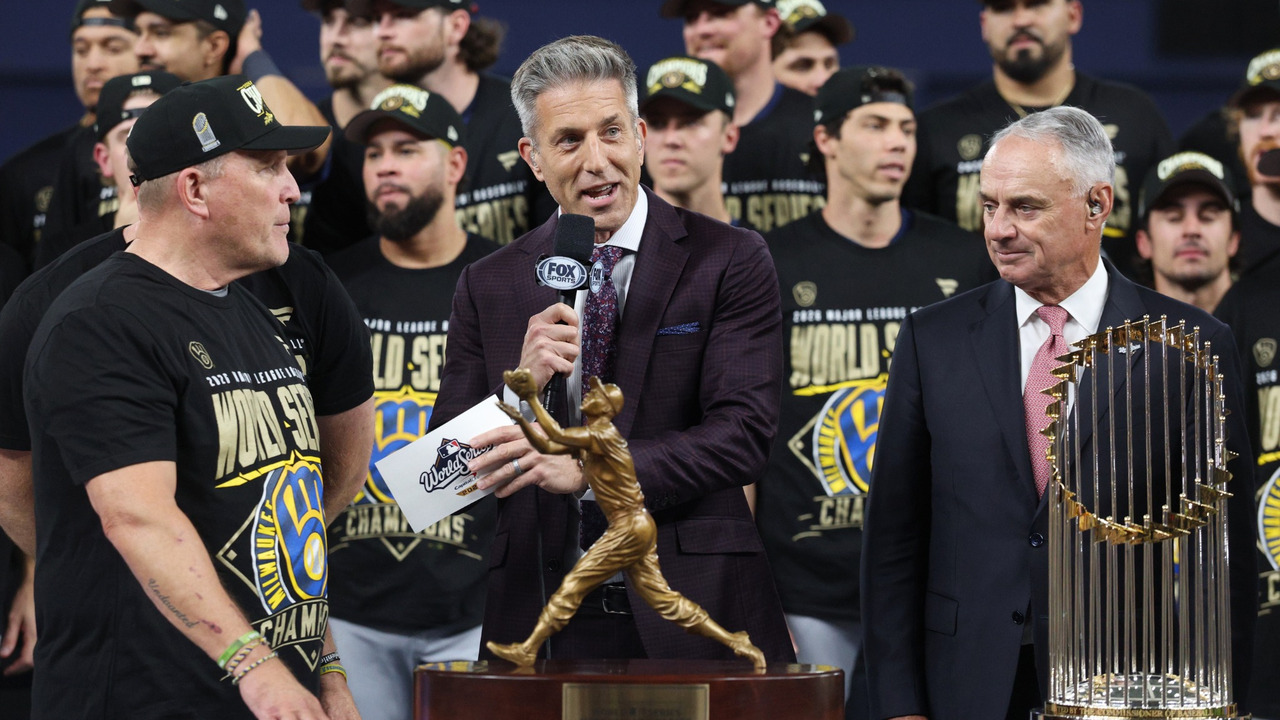
The Milwaukee Brewers and Tampa Bay Rays met in that World Series, the first in 35 years between two clubs in the bottom half of big league spending. Milwaukee won it last week. The Brewers ranked 19th in payroll as of Aug. 31, and the Rays ranked 25th.
Meyer’s case against the cap ran through those two clubs.
“There’s no reason whatsoever that the Pirates can’t do what the Brewers have done or what the Rays have done. None whatsoever, right?” Meyer explained.
In Meyer’s view, the owners are after higher profits and franchise values that they do not have to share with players.
“It is kind of sad that the league and the owners have once again been focusing not on the greatness of the game, not on the greatness of the players, not on the greatness of the playoffs, but they’ve been focusing on basically telling the consumers of their product that their product is broken,” Meyer said.
Commissioner Rob Manfred held his own session that day. The World Series matchup did not move the league off its position, Manfred said.
“Number one, we have an unprecedented level of unanimity among ownership that this is something that we need to do, that we need to get ourselves in a position to operate like all the other major professional sports in North America,” Manfred said.
“Secondly, and even more importantly to me, our fan polling, and we do it regularly, has moved hard in the direction of the fact that we have a problem and that our fans see a salary cap as the answer to that problem,” Manfred continued.
Milwaukee had not played in a World Series since 1982. Manfred brought up that gap himself.
“It’s been 40 years since we’re here. Once every 40 years is not enough,” Manfred explained. “It’s not that no small market can win, it’s just that it’s pretty rare.”
MLB last proposed a salary cap in 1994. A 7½-month strike followed, and that year’s World Series was canceled, the first time in 90 years it was not played.
Texas Rangers Payroll Sits Between The Proposed Cap And Floor
Spotrac put the Texas Rangers’ 2026 competitive balance tax payroll at about $238.9 million. Texas ranked 15th in the majors in payroll this year.
On Monday, Rangers president of baseball operations Chris Young said the 2027 payroll will be “very similar” to this season’s. Three players account for $92.5 million of the money already committed for 2027: Jacob deGrom at $37 million, Corey Seager at $31.5 million, and Nathan Eovaldi at $24 million. All three have complete no-trade clauses.
The interest other clubs show in current Rangers players will tell Texas how it can move money around, Young said.
“Our expectation is that we are going to put together a competitive team,” Young said. “As we gauge the interest in our current players, it allows us the ability to understand how we could reallocate. I think everybody knows we’re not going to have the exact same roster we had last season. There will be changes.”
“So, we are hard at work right now determining what those changes may be and understanding what the respective markets are. And that’s where trades are made,” Young continued. “You oftentimes trade one player to make yourself stronger in two different spots, and that’s what we’re looking to do.”
The Rangers do not have to move anybody, according to Young, and the decision covers more than next season.
“We’re looking at this as what is the best thing for the Texas Rangers in 2027 and beyond,” Young explained. “What is the health of our franchise, and how does that align with what we believe is a good spot for the farm system? We’re looking at this through a number of different angles. We’re just now getting into free agency. The next month, and through the offseason, will be spent having these conversations, determining what path we go down.”
Texas is coming off its third consecutive non-winning season. The general managers meetings begin next week.