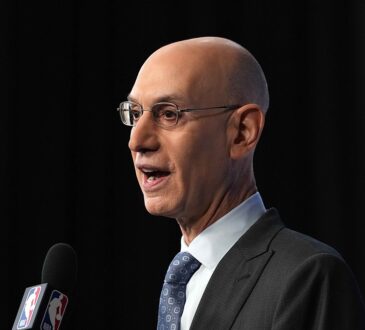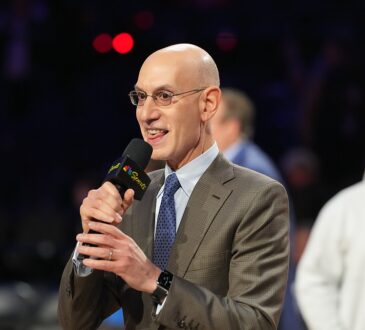
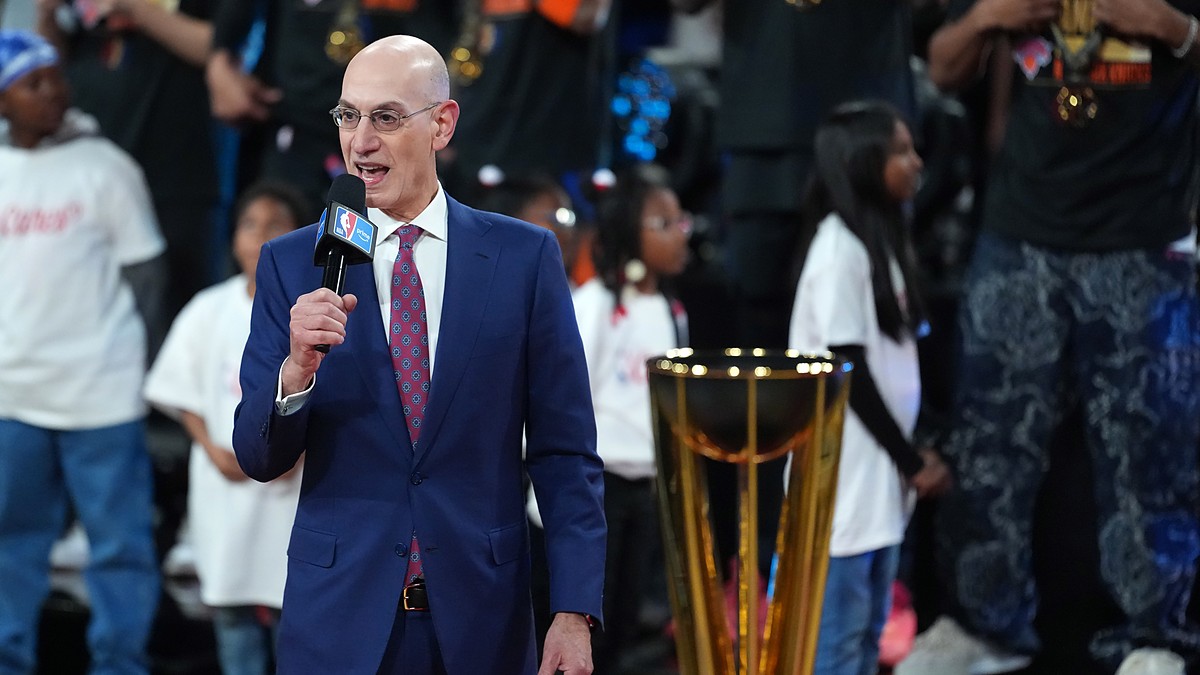
NEW YORK — NBA commissioner Adam Silver said Tuesday the league’s system is working pretty well and defended the second apron after the Board of Governors met in New York, while calling the union’s new leadership very healthy for the next round of bargaining.
David Kelly, the National Basketball Players Association’s executive director, was elected Feb. 13 and took over from Andre Iguodala at the end of July.
Adam Silver on the Second Apron and Parity
Silver does not remember a season where the competition was as hotly anticipated as this one.
“Specifically on the last part of your question, it did not impact ultimately the discipline,” Silver said. “I live in the world. I read what people write and say, and that’s OK. People have their opinions. Sometimes I’m influenced by them and sometimes I’m not. But largely I’m more influenced by reporting where it’s providing information to me that I don’t have.”
“I just say as sort of the commissioner of the NBA, this notion that I or any of my colleagues treat one owner differently than another because of that owner’s particular wealth or because of the market they’re in, I think you guys would see fairly quickly that we’re not operating a good league if that were to be the case,” Silver continued. “In fact, I should have said earlier, I think as a sign of progress, the fact that in this last Finals we had essentially the largest market playing against the small market, and that wasn’t part of the narrative at all.”
“And I think that speaks a little bit to your second apron question,” Silver added. “The point was to design a system, I’m not embarrassed to say more NFL-like, where every team was put in a position where regardless of market size, they could compete for championships. Eight different champions over the last eight years. That isn’t necessarily a sign of success. I’m fine if teams repeat, but I think over successive collective bargaining agreements and revenue sharing systems and other changes we’ve made, we’ve gotten closer to building the kind of parity of opportunity we want.”
The New York Knicks beat the San Antonio Spurs in the 2026 NBA Finals for their first championship since 1973. The second apron was introduced in the collective bargaining agreement that took effect with the 2023-24 season.
“And so even around the second apron, as I said, I think around our board meeting in Las Vegas, I don’t see the operation now as unintended consequences,” Silver noted. “I understand that for any individual player who is looking for a particular opportunity, we potentially impacted that player, but I also, as sort of goes to some of the earlier questions, it’s my job to look out for the fan bases of 30 teams, not just that situation for that one player or that one fan base. And when you look at the league operation in totality, I think the system is working pretty well.”
“Is it perfect? Of course not,” Silver detailed. “Certainly our players and our Players Association has made some comments about operation of the current system, but I think also we have strong relations with each other. We recognize there’ll be an opportunity to sit down as part of a new process. There’s always things that they want. There’s always things that we want. I think in any partnership, there’s trades made along the way.”
David Kelly and the Next Round of Bargaining
Kelly joined the NBPA in February 2025 as managing director and general counsel. Before that, he spent more than a decade with the Golden State Warriors, where he served as chief legal officer and earlier managed the team’s salary cap and collective bargaining matters, according to the union.
The league has its own list of changes for the next negotiation, as does the union.
“But it’s always with these systems that sometimes, even as people are analyzing them, there’s this sense that if I just could pull this one string and leave everything else in place, wouldn’t that be better? But of course, that’s never the case,” Silver explained. “And all of our systems are a result of many different trade-offs, like any fair negotiation. And then when that negotiation is over, of course, one side can say, well, that one thing that I really wanted, but what gets lost is the context of that 3 o’clock in the morning meeting when we made the trade that ultimately led to the final deal.”
“And it may be where unintended consequences come in is that when we sit back down, somebody may have misjudged how teams would perform or how players react to various aspects of the system,” Silver continued. “And just like the Players Association has their list, we have our list as well. And when we sit back down with them, I think we’ll have a very constructive conversation.”
“And I should add, with David Kelly, former general counsel of the Golden State Warriors, taking over our Players Association, I think that’s very healthy,” Silver added. “He knows our system as well as I do, and that actually, I think, lends itself to better conversations because of that sophistication across the table. We have Dan Rube here, our lead negotiator. That ability for them to have really nuanced conversations about systems, I think to the extent there’s changes we want to make, make those conversations more constructive, more productive, less emotional, less personal.”
Kelly also represented the union in the Clippers case. Silver said Kelly represented Kawhi Leonard well during that process.
“And again, to the extent that there are ways we can improve competition, improve player optionality, we’re happy to look at it,” Silver noted. “But as I said, certainly as compared to prior systems, I think this is the best system we’ve ever had. And to me, ultimately the judgment is made based on not just the competition on the floor, and I don’t remember a season, I should say, where the competition was as hotly anticipated as this year. There are so many good teams, so many interesting situations out there.”
“I think there’s a good blend of player movement together with, at the same time, players choosing to stay in their same markets,” Silver detailed. “I think that’s part of what adds excitement as well. And so that together with, as you said, some of the conversation around changing the lottery system, I think we’ve made real advancements in the level of competition in this league. And I’ll just end by saying I can’t wait for the season to start.”
Most teams open training camp Sept. 29. The Dallas Mavericks can open as early as Sept. 22 and begin the regular season Oct. 21 at Houston at 7:30 p.m. CT.